Chinese Duplitecture – A Strange Phenomena With Deep Roots
It's a piffling bit difficult and strange for everyone else to sympathise this but in China the mental attitude towards plagiarism and copying is not one of hostility but rather one of tolerance and fifty-fifty appreciation. Copycats are not viewed every bit cheats and they are not punished or judged in a negative mode. On the reverse, a good copier in China is historic as a talent.
 View in gallery
 This attitude is not something new in this function of the globe. It has deep historical roots beingness linked to China's commencement emperor, named Qin Shi Huang, famous for his terra cotta ground forces. After conquering rival kingdoms, the emperor would build replicas of each of their palaces within his own capital letter urban center.
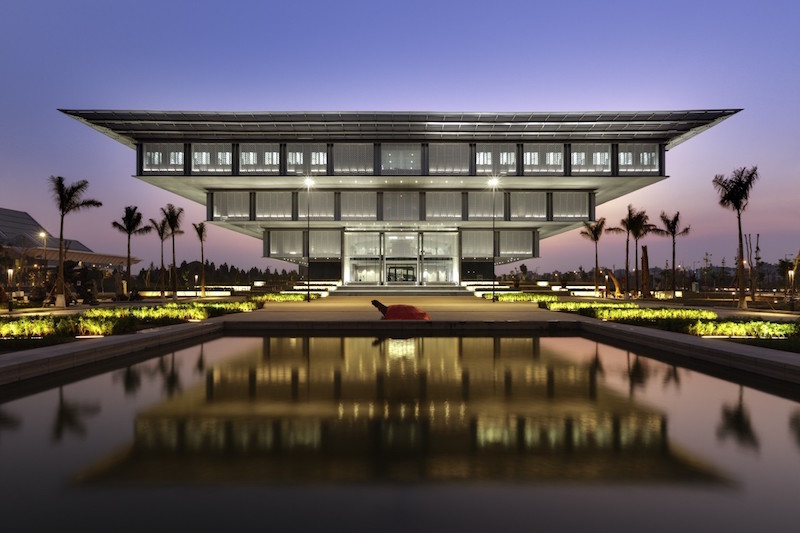
The Hanoi Museum
 View in gallery
 This is the Hanoi Museum, a famous landmark in Vietnam. Information technology was designed by gmp Architekten in 2010, the same year that the Cathay Art Museum was completed. Also called the China Art Palace, the structure was located in Pudong, Shanghai, being i of the largest art museums in Asia. The two building are evidently very similar even though at that place are as well striking differences between them.
 View in gallery
 Over time, People's republic of china became a copy-friendly environment where imitation was encouraged. Mimicry became a course of mastery and we at present know that the Chinese copy simply about everything and this doesn't resume only to phones or clothing just to larger things as well. In that location'south this trend of replicating architecture from effectually the world which has been named duplitecture.
 View in gallery
 The phenomena is a very serious matter. China has its own replicas of famous landmarks such as the Eiffel Tower, the White House, the U.s.a. Capitol, Tower Bridge and even historical monuments such as the Colosseum, the Sphinx, the Moai statues on Easter Island, the Leaning Tower of Pisa and fifty-fifty Stonehenge.
 View in gallery
 This may come as a surprise but the Chinese even copied whole towns and brought them to their doorstep. Areas such as Thames Boondocks, Venice and even a hamlet in Austria were copied in China. At 1 betoken, the Shanghai government issued a programme chosen "One City, Ix Towns" which basically meant that x satellite towns would be built around Shanghai and each would feature the architectural way of a dissimilar European nation.
Notre Dame du Ronchamp
 View in gallery
 Well-nigh commonly known equally Ronchamp, this cute masterpiece was designed by Le Corbusier. The idea dorsum in 1950 was to design a new Catholic church building to supervene upon the original i destroyed during World War 2. Aiming for a pure blueprint in contrast with the extravagance of its predecessor, the new church was completed in 1954. A replica of it was later congenital in China but was demolished in 2008.
 View in gallery
 These mirror cities don't just copy the compages of the original merely besides effort to create the aforementioned ambiance. Earlier starting such a project, the Chinese developers travel abroad to study the boondocks they intend to re-create and to brand certain that their creation is every bit faithful to the original as possible. They recreate both the look and the feel of the town.
 View in gallery
 In the case of a theme boondocks such as Thames, the Chinese architects replicated the layout of the original equally well as major British landmarks in an effort to brand this fantasy more believable and authentic. They as well imported bits of civilisation, giving the streets English names or creating pubs with British themes. The replica version of Venice fifty-fifty has gondolas and all sorts of other symbols imported from the original city.
 View in gallery
 This unusual form of architectural mimicry is odd for the other nations, especially considering the fact that these towns are not theme parks simply actual neighborhoods where people alive out their lives. For them, this is a way to testify off their success and sophistication. It's true nonetheless that not all of these replica cities are popular with residents.
VitraHaus
 View in gallery
 The VitraHaus building was designed by Herzog & de Meuron in Frg, as part of the Vitra Campus. The complex is a sort of architecture museum, featuring works of famous architects such Frank Ghery, Zaha Hadid, Tadao Ando or Nicholas Grimshaw. Its design is equanimous of a serial of stacked boxes with pitched roofs, each with a different orientation. This design was copied by Sou Fujimoto Architects when they designed an apartment complex composed of 4 house-shaped apartments stacked on tiptop of each other.
 View in gallery
 Thames Town, for instance, is not the most populated area. It is, however, a famous location for wedding ceremony photos considering of all the replicated cultural elements such equally the cherry phone boots or the security guards dressed in British-inspired uniforms.
 View in gallery
 Some such projects were not well-received by their original counterpart. For example, the Ronchamp chapel in France was at 1 point replicated in Zhengzhou and after a series of conflicts the facade of the replica was torn down.
 View in gallery
 It's difficult to say whether this copycat architecture tendency has a positive or a negative impact on People's republic of china. Some Chinese architects have expressed their revolt, considering that the phenomena causes Mainland china to gradually lose its identity and history. Chinese scholars also expressed their concerns nigh the hereafter of Chinese architecture, fearing that this would lead to a lack of cultural self-confidence and originality.
buergerhaductincer.blogspot.com
Source: https://www.homedit.com/chinese-duplitecture/
Belum ada Komentar untuk "Chinese Duplitecture – A Strange Phenomena With Deep Roots"
Posting Komentar