what is a healthy oil to fry with
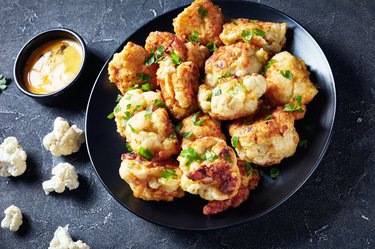
Choose a cooking oil with a high fume point.
Epitome Credit: from_my_point_of_view/iStock/GettyImages
Deep frying is a cooking method that seals in the moisture, resulting in a crispy surface and enhanced gustation and texture. When choosing the best oil for frying, consider the characteristics of each production, including how information technology's processed, thermal stability, viscosity and overall wellness benefits.
Tip
For deep frying, cull a neutral-flavored oil — preferably unrefined — with a high smoke bespeak. Ideally, look for 1 rich in monounsaturated fatty acids and low in saturated fat.
Why Smoke Bespeak Is Important
One of the about of import considerations when selecting the best oil for frying is how it will react when heated. Deep frying involves using a cooking temperature higher than 212 degrees Fahrenheit (the temperature of boiling water). Cooking oil tin can be brought to much higher temperatures, which are required to create that delicious crispy browning effect.
The temperature that causes a particular oil to start to burn and oxidize is called the "smoke point." Heating cooking oil to a higher temperature than its fume signal causes deposition that tin produce toxic fumes and harmful complimentary radicals. Some of these by-products tin have adverse furnishings on health, warns a May 2018 research article in ACTA Scientific Nutritional Health.
When deep-frying, it's important to choose an oil with a high smoke betoken. According to the Canola Quango, frying requires maintaining the oil temperature at 365 to 375 F.
Adding food to the oil will initially lower the temperature, so it's best to preheat the oil to well-nigh xv F higher than the optimal deep-frying temperature. Therefore, yous should use oils with a smoke point of around 400 F. Those with a lower smoke signal may not withstand loftier rut, so they may be the healthiest oils for pan-frying or low-temperature cooking.
Cooking oils rich in saturated and monounsaturated fats generally have the highest smoke points and are more than resistant to oxidation, according to a May 2015 study in Advances in Nutrition. Conversely, those high in polyunsaturated fats degrade more easily considering they incorporate brusk-chain fatty acids that break apart when heated.
Unrefined vs. Refined Oils
Several processes are used to extract oil from plants, seeds and basics. This tin can be washed through the use of pressure, such as cold-pressing, or mechanical, thermal or chemical processes.
Manufacturers refine the oil to ensure purity and clarity, decrease rancidity for longer storage and brand their products more than resistant to smoking. The more refined the oil, the higher the smoke point, co-ordinate to the American Quango on Exercise.
Simply, the refining process affects not merely the flavor but likewise the levels of polyphenols, which aid protect your cells from oxidative damage, per PennState Extension. Processing may too reduce the micronutrients in oil equally well as its antioxidant activity and create lipid degradation. This will ultimately affect the potential health benefits of oil, per a March 2019 study in PLOS One.
Most oils you observe on supermarket shelves are refined, although many are also bachelor unrefined, albeit oftentimes expensive. Whenever possible, choose oils with high fume points in their virtually natural form, such virgin, unrefined or common cold-pressed versions.
Cooking Oil Smoke Points
Post-obit is a comparing of smoke points of some common oils that can withstand loftier cooking temperatures, co-ordinate to the Canola Quango of Canada and the Harvard T.H. Chan School of Public Health:
| Oil Type | Smoke Point |
| Olive Oil (Processed) | 428 F |
| Olive Oil, Actress Virgin | 331 F |
| Canola Oil | 468 F |
| Canola, High Oleic | 475 F |
| Kokosnoot Oil (Refined) | 400 to 450 F |
| Coconut Oil, Virgin and Extra Virgin | 350 F |
| Corn Oil | 453 F |
| Peanut Oil | 471 F |
| Soybean Oil | 453 F |
| Safflower, High Oleic | 468 F |
Source: Canola Council of Canada and University of Lethbridge; Harvard T.H. Chan Schoolhouse of Public Health.
Wellness Benefits of Dietary Fatty
Your trunk needs fats to part properly. Fats are integral to cell construction and help maintain musculus contraction, blood clotting, immune role and blood pressure, co-ordinate to the American Council on Exercise.
This nutrient is also required for the absorption of fat-soluble vitamins, such as vitamins A, D, E and K. The Dietary Guidelines for Americans recommend that you get 25 to 35 percent of your daily calories from fat.
The fat in oil comprises a mixture of fatty acids, both saturated and unsaturated. Unsaturated fats, which include monounsaturated and polyunsaturated fatty acids, are the healthiest choice.
Polyunsaturated fats include omega-iii and omega-half dozen fat acids that assist form hormone-like compounds needed to regulate actual functions. Omega-3s play a function in reducing inflammation and protect confronting diseases, such every bit arthritis, lupus and asthma, per PennState Extension. Omega-6 fat acids increment inflammatory response to infection and injury. They help increment clotting and restrict blood vessel size, reducing bleeding.
Monounsaturated fats are liquid at room temperature and plow solid when chilled. Oils rich in monounsaturated fats, such as oleic acid, may assistance reduce LDL (bad) cholesterol levels and protect against cardiovascular disease. These salubrious fats as well contribute the antioxidant vitamin E to your nutrition, according to the American Middle Association.
Saturated fats tin can be found in oils that are solid at room temperature. They may negatively bear upon your wellness and pb to heart disease and weight gain, states the U.S. National Library of Medicine. Oils that contain the most saturated fat include tropical oils, such as coconut and palm oils. The Dietary Guidelines recommend limiting your intake of saturated fat to less than 10 pct of your calories.
Comparing the Fats in Oils
The following chart compares the amount of saturated, monounsaturated (MUFA) and polyunsaturated fats (PUFA) in 100 grams (3.five ounces) of diverse oils with a medium-to-high fume point.
In general, the lower the amount of saturated fat and the higher the content of unsaturated fat, the healthier the oil is.
Trans fats grade when vegetable oils are hydrogenated into shortening and stick margarine. This results in partially hydrogenated oil, which tin can negatively affect your health and increase the risk of heart disease, according to a report in the July-August 2016 issue of Indian Heart Journal.
The Best Oil for Frying
Some of the all-time oils for frying accept a high smoke betoken, comprise healthy monounsaturated fats and are depression in saturated fats. These include olive, canola, corn and safflower high oleic oils.
Actress virgin olive oil (EVOO) is an integral component of the Mediterranean diet. It's rich in monounsaturated fats, which makes it less likely to oxidize at high temperatures.
Even though it has a lower smoke point than some other oils, it can be used for frying. According to the study in ACTA Scientific Nutritional Health, additional factors, such equally oxidative stability, may also play an of import role in determining the suitability of use in high-temperature cooking.
Researchers heated extra virgin olive oil to 464 F and maintained it at 356 F for 6 hours. EVOO yielded lower levels of oxidative by-products compared to other oils tested — virgin olive oil, olive oil, canola oil, rice bran oil, grapeseed oil, coconut oil, peanut oil, sunflower oil and avocado oil. Its fatty acrid profile and antioxidant content were the most stable, followed by coconut oil and other virgin oils, like avocado and high oleic acrid seed oils.
A May 2017 Comprehensive Reviews in Food Science and Food Safety written report reports similar findings: Olive oil performed similarly or better than other vegetable oils when heated, and frying with virgin olive oil and EVOO is linked to disease prevention, reduced insulin resistance and a lower run a risk of heart disease.
Canola oil is another good choice. It'south typically sold equally refined oil and extracted using heat and a solvent called hexane. There has been some concern that hexane may impact its stability, destroy omega-3s and even create trans fats, according to the Harvard T.H. Chan Schoolhouse of Public Wellness.
But researchers say in that location is no evidence to confirm that hexane poses any health risks, considering the small corporeality ingested from canola oil. Plus, due to deodorizing during refinement, canola oil contains very depression levels of trans fat, although this process likewise reduces its levels of omega-3s.
High-oleic canola oil contains more than monounsaturated and less polyunsaturated fats. This makes information technology more than stable, allowing for greater heat tolerance and a meliorate choice for deep frying when compared to other oils loftier in polyunsaturated fats, such as corn, peanut and safflower, per the Canola Council.
You lot can also opt for sunflower oil. Although it has a high smoke point, a June 2017 written report in the European Journal of Nutrition reported that using sunflower oil for frying increases Dna oxidative damage subsequently ingestion, whereas virgin olive oil has the contrary effect.
Best Olive Oils to Purchase
- California Olive Ranch Actress Virgin Olive Oil (36.99, Amazon)
- Lucini Organic Premium Select Extra Virgin Olive Oil ($23, Amazon)
- California Olive Ranch Everyday Extra Virgin Olive Oil ($23.65, Amazon)
buergerhaductincer.blogspot.com
Source: https://www.livestrong.com/article/439912-what-is-the-healthiest-cooking-oil-for-deep-frying/
Belum ada Komentar untuk "what is a healthy oil to fry with"
Posting Komentar